
20th century women's fashion: vintage style guide
Fashion throughout the 20th century wasn’t just about hemlines and silhouettes. It was a visual language of revolution, restriction, and reinvention that mirrored women’s evolving freedoms. Each decade brought shifts that reflected societal upheaval, from the corset’s grip to the miniskirt’s defiance. Understanding this history of women’s fashion evolution offers more than nostalgia. It provides a roadmap for expressing your authentic self through clothing that carries cultural weight and personal meaning. This guide explores key fashion eras, practical advice for incorporating vintage pieces, and inspiration for confident style choices that honor the past while celebrating your individuality.
Table of Contents
- Evolution Of Women’s Fashion In The 20th Century
- Iconic Styles And Their Cultural Meanings
- Incorporating Vintage 20th Century Fashion Into Modern Wardrobes
- Fashion’s Role In Status And Self-Expression Throughout The 20th Century
- Explore Vintage-Inspired Styles At Be Juliet
Key takeaways
| Point | Details |
|---|---|
| Fashion reflected social change | Major 20th century shifts in women’s clothing mirrored evolving roles, freedoms, and cultural expectations across decades. |
| Construction knowledge matters | Understanding vintage garment structure and sizing differences is essential for successful modern styling and tailoring. |
| The ‘New Look’ carried dual meaning | Post-war glamour symbolized both couture revival and restrictive social ideals tied to domesticity. |
| Vintage enhances modern expression | Thoughtfully blending historical pieces with contemporary styles creates unique, personally meaningful wardrobes. |
Evolution of women’s fashion in the 20th century
The early 1900s locked women into restrictive corsets and floor-length skirts that physically limited movement while reinforcing social conventions about proper femininity. Women’s bodies were shaped to fit an S-curve silhouette that prioritized appearance over comfort or functionality. This constraint extended beyond clothing into expectations about behavior, mobility, and social participation.
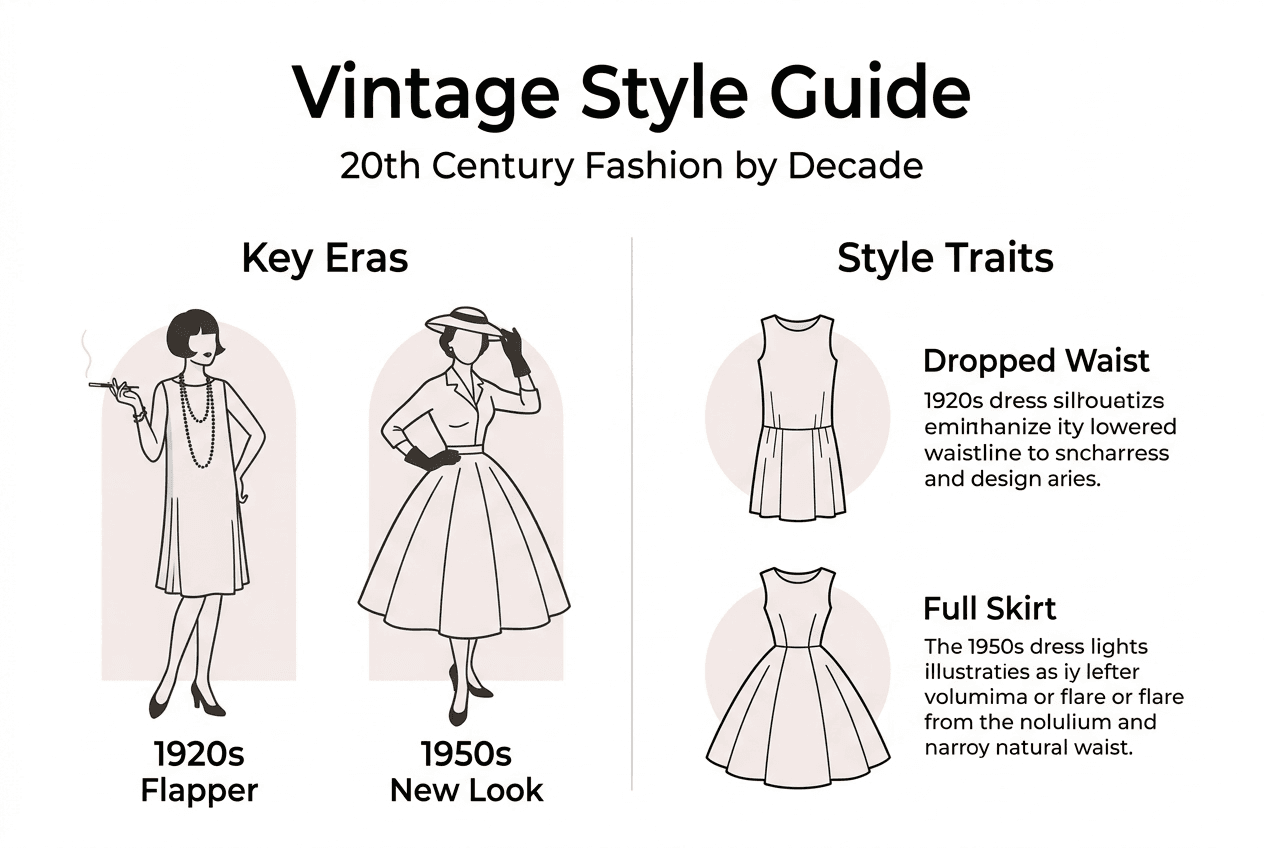
The 1920s shattered these conventions. Liberated styles with dropped waists reflected newfound freedoms as women gained voting rights and entered the workforce in unprecedented numbers. Hemlines rose to the knee, corsets disappeared, and the boyish flapper silhouette celebrated youth culture and rebellion. This wasn’t just fashion change. It was visible proof of social transformation.
Wartime necessity during the 1940s brought practicality to the forefront. Fabric rationing meant simpler designs with shorter skirts and minimal embellishment. Women working in factories needed clothing that allowed movement and durability. The evolution of women’s fashion during this period demonstrated how external pressures directly shaped what women wore and how they moved through the world.
Post-war 1950s fashion took a dramatic turn with Christian Dior’s ‘New Look’ in 1947. This revival emphasized cinched waists, full skirts, and an exaggerated hourglass silhouette that consumed yards of fabric. The style represented a return to pre-war couture luxury and idealized femininity, yet it also signaled new social constraints as women were encouraged to leave wartime jobs and return to domestic roles.
The 1960s youthquake revolutionized fashion accessibility. Ready-to-wear clothing made early 1960s women’s fashion available beyond elite circles, democratizing style for the first time. Mini skirts, shift dresses, and bold patterns reflected youth rebellion and changing attitudes about sexuality, work, and women’s autonomy.
Key transformations across these decades:
- Silhouettes shifted from restrictive to liberating, reflecting women’s increasing social freedoms
- Fabric technology and production methods evolved from handmade couture to mass-produced ready-to-wear
- Hemlines rose and fell in direct correlation with economic conditions and social attitudes
- Practicality gained importance during wartime, influencing lasting changes in everyday clothing
- Youth culture emerged as a driving force in fashion innovation, challenging traditional age hierarchies
Iconic styles and their cultural meanings
Dior’s ‘New Look’ stands as one of fashion history’s most complex symbols. The style represented a revival of pre-war silhouettes and the couture industry, yet became intertwined with social confinement. The cinched waist and voluminous skirts required foundation garments that restricted movement, echoing earlier corsetry in new forms.
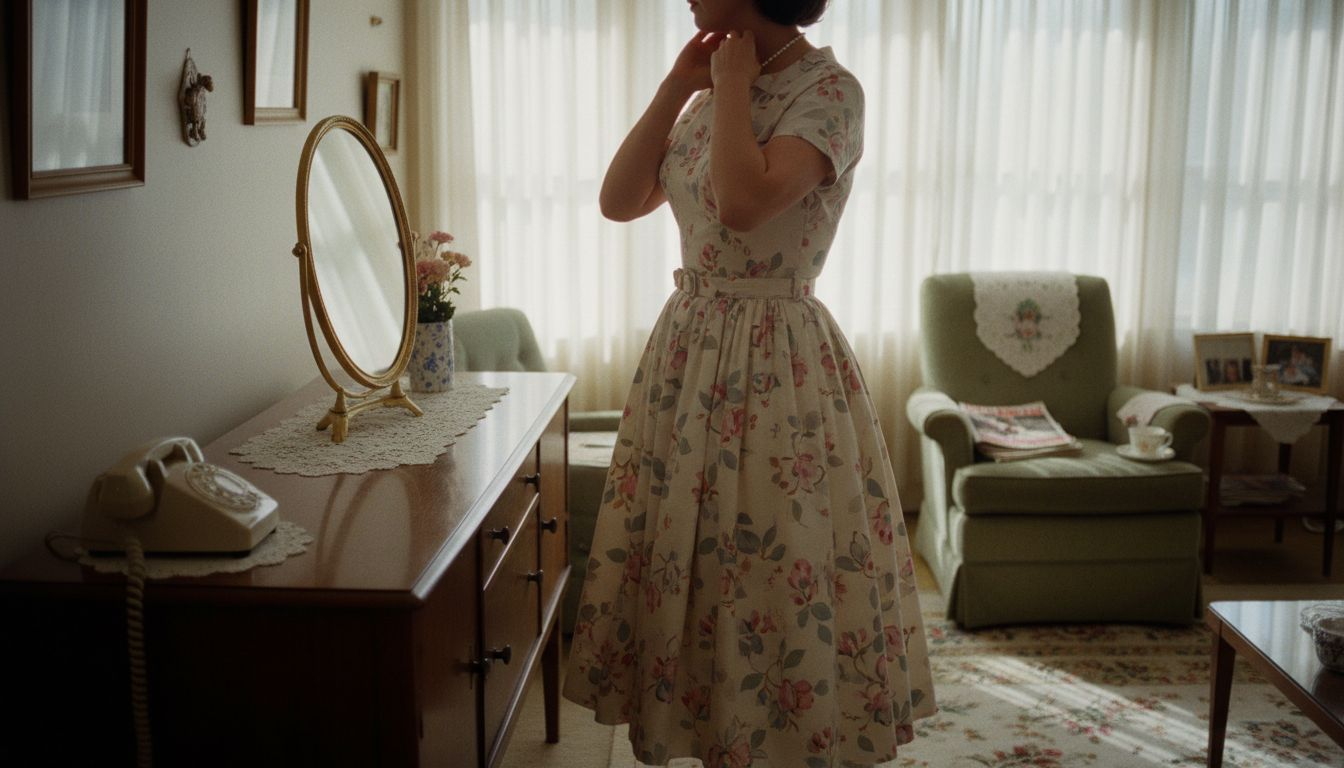
This wasn’t accidental symbolism. The ‘New Look’ was associated with suburban motherhood and wifehood in the 1950s, visually reinforcing post-war domestic ideology. Women who had worked in factories and offices during wartime found themselves dressed in clothing that limited their physical capabilities while emphasizing traditional feminine roles. The style communicated status through its fabric consumption and tailoring requirements, accessible primarily to middle and upper-class women.
The house dress occupied different cultural territory. This practical garment symbolized domestic labor and daily routines, worn by women managing households without hired help. Unlike the ‘New Look’ glamour, house dresses prioritized washability, comfort, and affordability. They represented the reality of women’s daily lives versus the idealized image promoted in fashion magazines.
“Fashion is more than clothing, it is a language of status, aspiration and anxiety.”
This quote captures fashion’s communicative power throughout the 20th century. What women wore signaled their economic position, social aspirations, and cultural values. Luxury fashion discourse dominated from 1910 to 1970, with publications like Vogue expressing elite aspirations and anxieties about maintaining social distinctions as ready-to-wear democratized style.
Fashion’s symbolic layers operated simultaneously:
- Economic signals through fabric quality, construction methods, and brand associations
- Social messaging about marital status, age appropriateness, and professional identity
- Political statements through adoption or rejection of mainstream trends
- Cultural belonging communicated through subcultural dress codes and regional variations
- Personal aspiration expressed through emulation of celebrity and upper-class styles
Understanding these meanings enriches how we approach vintage fashion today. Each piece carries historical weight beyond its aesthetic appeal, connecting wearers to broader cultural narratives about why fashion matters in shaping identity and social perception.
Incorporating vintage 20th century fashion into modern wardrobes
Blending vintage pieces with contemporary style requires understanding garment construction and historical context. The incorporation of vintage elements into modern wardrobes allows for self-expression and individuality that mass-produced fashion rarely achieves. Each vintage piece tells a story while offering unique details like hand-stitching, quality fabrics, and silhouettes unavailable in current retail.
Start by examining garment construction before purchasing. Look at seam finishes, fabric weight, and closure types. Vintage pieces often feature French seams, bound buttonholes, and interfacing techniques that indicate quality and durability. Understanding fashion terminology helps you evaluate construction and communicate with tailors about necessary adjustments.
Sizing presents the biggest challenge when wearing vintage clothing. Vintage sizing is unpredictable, and tailoring is often necessary. A labeled size 12 from 1950 might measure closer to a modern size 4. Always measure garments directly rather than relying on size labels. Common alterations include taking in or letting out waists, adjusting hem lengths, and modifying shoulder widths to accommodate modern proportions.
Pro Tip: Bring a fabric tape measure when vintage shopping and know your exact measurements for bust, waist, hips, and shoulder width. Compare these to garment measurements while accounting for ease needed in different fabric types.
Practical steps for successful vintage integration:
- Start with accessories like scarves, belts, or jewelry to test your comfort with vintage aesthetics
- Choose one statement vintage piece per outfit, balancing it with contemporary basics
- Consider the garment’s original context and reinterpret it for modern settings
- Invest in professional tailoring for structural changes beyond basic hemming
- Learn basic garment care for vintage fabrics, including hand washing and proper storage
- Mix decades thoughtfully rather than creating costume-like period outfits
- Focus on fit and proportion over authenticity when styling for daily wear
| Vintage Era | Signature Silhouette | Modern Equivalent | Styling Approach | | — | — | — | | 1920s | Dropped waist, straight | Shift dresses, tunics | Pair with contemporary denim or tailored trousers | | 1940s | Broad shoulders, nipped waist | Structured blazers | Mix with relaxed bottoms for balance | | 1950s | Full skirt, fitted bodice | Fit and flare dresses | Modernize with minimal accessories and simple shoes | | 1960s | A-line, mod styles | Shift dresses, mini skirts | Layer with contemporary outerwear |
The key to successful vintage styling lies in maintaining your personal aesthetic while honoring the garment’s original character. This approach to fashion and self-identity creates wardrobes that feel authentic rather than derivative. You’re not recreating the past but drawing inspiration from it to express your present-day individuality.
Fashion’s role in status and self-expression throughout the 20th century
Clothing communicated complex social messages long before Instagram made outfit documentation ubiquitous. Throughout the 20th century, fashion functioned as a sophisticated language encoding status, aspiration, and cultural anxiety. What you wore announced your economic position, social ambitions, and cultural values without speaking a word.
The relationship between visible luxury and elite income was particularly pronounced from 1910 to 1970. Fashion magazines like Vogue served as cultural arbiters, defining acceptable styles for different social classes and occasions. This created aspirational consumption patterns where middle-class women emulated upper-class fashion through more affordable versions, maintaining social hierarchies through dress codes.
The rise of ready-to-wear in the 1960s fundamentally disrupted these patterns. When similar styles became accessible across economic classes, fashion’s role in status signaling shifted. Instead of fabric quality and couture construction, brand names and subcultural affiliations became new markers of distinction. This democratization changed how women used clothing for self-expression, opening possibilities beyond class-based imitation.
Vintage fashion pieces carry this symbolic weight across generations. A 1940s tailored jacket doesn’t just offer quality construction. It connects the wearer to wartime resilience and women’s workforce participation. A 1970s peasant blouse references counterculture values and feminist movements. These garments enable conversations between past and present, allowing modern women to claim historical narratives as part of their style confidence.
“Fashion is more than clothing, it is a language of status, aspiration and anxiety.”
This linguistic function operates on multiple levels:
- Personal identity construction through conscious style choices that communicate values and affiliations
- Social belonging signaled through adoption of group-specific dress codes and trends
- Economic positioning displayed via garment quality, brand associations, and trend awareness
- Cultural resistance expressed through rejection of mainstream fashion norms
- Generational identity marked by distinct silhouettes, colors, and styling approaches
- Professional credibility established through context-appropriate clothing choices
Understanding fashion’s communicative power explains why vintage pieces resonate beyond nostalgia. They offer access to alternative narratives about femininity, work, sexuality, and social participation. When you wear a vintage garment, you’re not just choosing an aesthetic. You’re claiming a piece of cultural history and reinterpreting it through your contemporary lens. This makes vintage fashion a uniquely powerful tool for women seeking to express individuality in an era of fast fashion homogeneity.
Explore vintage-inspired styles at Be Juliet
Your wardrobe should tell your story while honoring the fashion movements that paved the way for self-expression. At Be Juliet, we create pieces that channel vintage inspiration through a modern lens, blending comfort with statement-making style. Our collections understand that authentic self-expression means having options for every mood, from bold confidence to relaxed ease.
The Love That For You Sweatshirt captures retro typography vibes with contemporary comfort, perfect for days when you want nostalgic charm without sacrificing ease. Our Serena Dreams Tennis-Inspired Sweatshirt nods to athletic elegance from past decades while keeping you effortlessly stylish today. For moments when you lead with love, the Valentine’s Day LOVE Sweatshirt makes a timeless statement that transcends seasonal trends. Each piece invites you to build a wardrobe that celebrates both classic influences and your evolving personal style.
FAQ
What are key fashion changes for women in the 20th century?
Fashion evolved from restrictive early 1900s corsets to liberating 1920s dropped-waist styles reflecting women’s newfound freedoms. Wartime 1940s brought practical designs with fabric rationing, while the 1950s ‘New Look’ reintroduced glamour with cinched waists and full skirts. The 1960s democratized fashion through ready-to-wear, making style accessible beyond elite circles and empowering youth-driven trends.
How do I manage sizing when buying vintage clothing?
Vintage sizing varies dramatically from modern standards, with a 1950s size 12 often measuring closer to today’s size 4. Always measure garments directly across bust, waist, and hips rather than trusting labels. Professional tailoring typically addresses waist adjustments, hem lengths, and shoulder modifications to achieve proper fit with vintage proportions.
What does the ‘New Look’ symbolize in fashion history?
The ‘New Look’ combined post-war couture elegance with restrictive social ideals about femininity and domesticity. Introduced in 1947, it represented both fashion industry revival and cultural pressure for women to leave wartime jobs and embrace suburban homemaking. This dual nature illustrates how fashion simultaneously liberates and constrains, reflecting complex social negotiations about women’s roles.
Why does vintage fashion matter for modern self-expression?
Vintage pieces offer unique construction quality, distinctive silhouettes, and cultural narratives unavailable in mass-produced contemporary fashion. Each garment connects you to historical movements while providing aesthetic differentiation in an era of fast fashion homogeneity. This combination enables authentic personal style that honors the past while expressing present-day individuality.
How can I blend vintage pieces without looking costume-like?
Choose one statement vintage item per outfit and balance it with contemporary basics in neutral colors. Focus on fit and proportion rather than period authenticity, mixing decades thoughtfully instead of recreating complete historical looks. Modern accessories, shoes, and styling techniques keep vintage garments feeling current while preserving their distinctive character.