
1800s women's fashion blends vintage and modern style
Most people picture Victorian fashion as suffocating corsets and impossibly heavy gowns. Reality? The 1800s offered surprisingly varied and practical styles that evolved alongside political revolutions, industrial advances, and shifting social norms. You’ll discover how Empire silhouettes, Victorian hourglass shapes, and dramatic bustles each reflected their era’s values while offering more flexibility than popular culture suggests. This guide reveals authentic historical insights and actionable tips to confidently incorporate 1800s vintage elements into your contemporary wardrobe.
Table of Contents
- Introduction To 1800s Women’s Fashion
- Early 1800s: Neoclassical Influence And Empire Silhouette
- Mid 1800s: Victorian Style And Structured Silhouettes
- Late 1800s: Bustle Era And Dramatic Volume
- Accessories And Social Significance
- Impact Of Industrial Revolution On Fashion Production
- Common Misconceptions About 1800s Fashion
- Social Class Influence On Fashion Styles
- Transition From Empire To Victorian Style
- Modern Application Of 1800s Fashion
- Explore Vintage Inspired Styles At Be Juliet
- What Defined Women’s Fashion In The 1800s?
- How Did Social Class Influence 1800s Women’s Fashion?
- Can 1800s Fashion Styles Be Incorporated Into Modern Wardrobes?
Key takeaways
| Point | Details |
|---|---|
| Three distinct style phases | Empire silhouette emphasized neoclassical simplicity, Victorian era introduced structured corsetry, and Bustle period created dramatic back volume. |
| Industrial revolution impact | Mass production enabled by sewing machines made elaborate garments accessible beyond the wealthy elite. |
| Fashion reflected social status | Upper classes wore expensive fabrics and intricate decoration while working women chose practical, simpler styles. |
| Versatility overlooked | Many 1800s garments prioritized comfort and movement, especially informal and summer styles that often lacked restrictive undergarments. |
| Modern styling potential | Vintage inspired silhouettes and accessories blend seamlessly with contemporary fabrics and cuts for unique, wearable looks. |
Introduction to 1800s women’s fashion
The 19th century witnessed radical transformation in women’s fashion driven by unprecedented political, social, and technological change. Women’s fashion evolved alongside major shifts including the French Revolution, rise of industrial manufacturing, and evolving class structures. These forces shaped everything from fabric choices to silhouette proportions.
Three primary drivers revolutionized fashion throughout the century:
- Political upheaval: Revolutionary ideals promoted democratic values reflected in simpler, neoclassical inspired dress during the early 1800s
- Social class dynamics: Fashion became a visible marker of wealth, status, and propriety with distinct styles separating upper and working classes
- Industrial advances: Mechanized textile production and the sewing machine democratized access to complex garments previously available only to elites
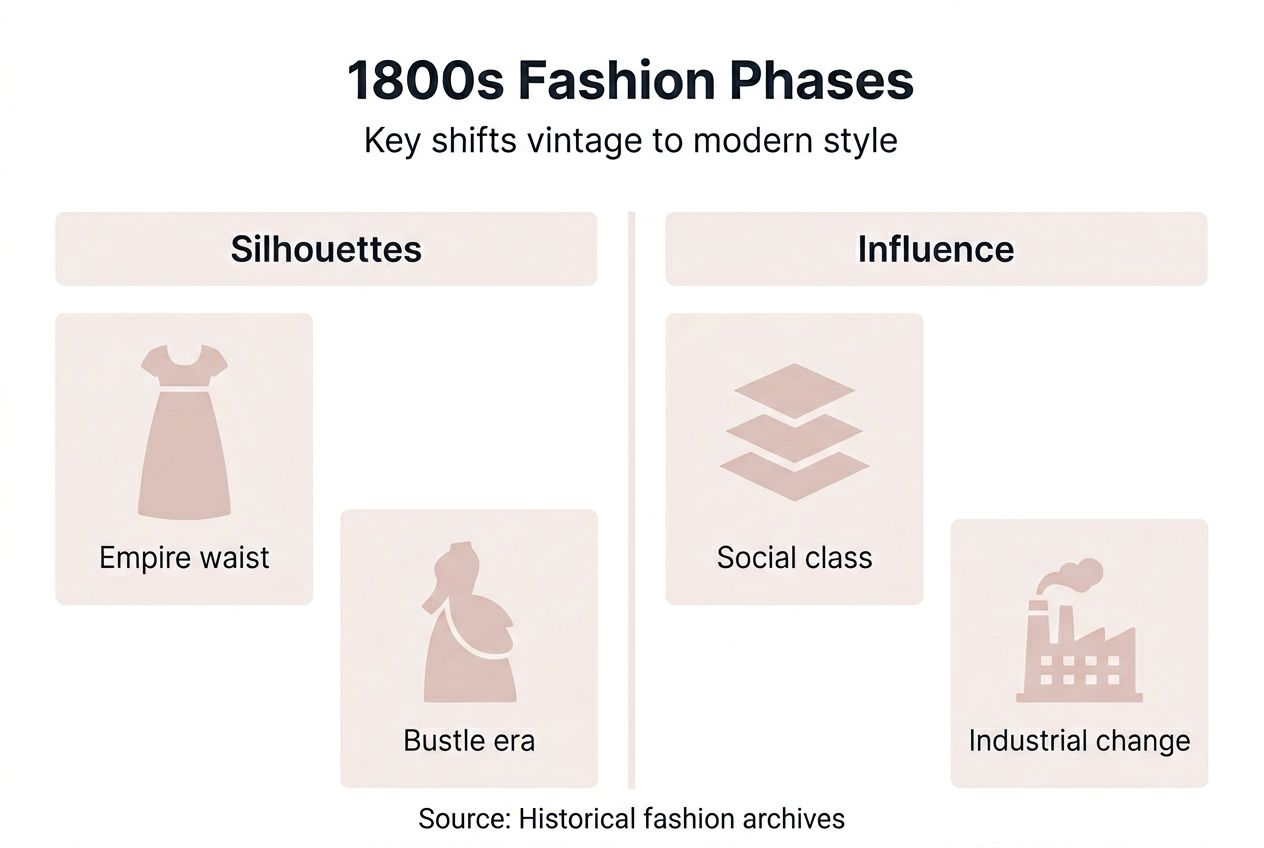
Silhouettes transitioned dramatically from the high waisted, flowing Empire style dominating 1800 through the 1820s to the structured Victorian hourglass of mid century, culminating in the bustle era’s exaggerated back volume by the 1870s and 1880s. Each phase carried distinct aesthetic values and practical implications.
Understanding these foundational shifts provides essential context for appreciating how 1800s fashion balanced beauty with function. The century’s styles weren’t simply restrictive costumes but reflected genuine responses to their cultural moment. This knowledge empowers you to thoughtfully incorporate vintage elements into modern outfits.
Early 1800s: neoclassical influence and empire silhouette
The Empire waistline reflected Greek and Roman ideals emerging from French Revolutionary values emphasizing natural beauty over aristocratic excess. This distinctive style positioned the waistline just below the bust, creating an elongated, columnar silhouette that flowed gracefully to the floor.
Key characteristics defined the Empire look:
- High waist placement: Bodices ended immediately under the bust with gathered or pleated skirts falling straight down
- Lightweight fabrics: Muslin, cotton, and fine linen allowed comfortable movement and created soft draping effects
- Pale color palettes: White dominated as the fashionable choice symbolizing purity and virtue, with pastels as popular alternatives
- Minimal ornamentation: Simple embroidery, delicate ribbons, and classical motifs replaced elaborate rococo decoration
This style connected directly to Greco Roman antiquity, mirroring the tunics and chitons worn in classical civilizations. Women appreciated the comfort and ease of movement these dresses provided compared to previous corseted styles. The look symbolized Enlightenment ideals valuing reason, democracy, and rejection of excessive monarchy associated luxury.
Pro Tip: Modern Empire waist dresses work beautifully for apple and pear body shapes by drawing attention upward and creating a flattering vertical line.
The neoclassical aesthetic dominated roughly 1800 through the 1820s before gradually giving way to more structured silhouettes. Its influence persists in contemporary fashion through Empire waist gowns, flowing maxi dresses, and Regency inspired designs appearing in period dramas and vintage collections.
Mid 1800s: Victorian style and structured silhouettes
Victorian fashion transformed the female form through corsets and crinolines creating hourglass shapes that epitomized mid 19th century ideals of femininity and domesticity. This dramatic shift from Empire simplicity reflected industrial prosperity, rising middle class values, and evolving social expectations.
The structured Victorian look involved multiple elements:
- Corset foundation: Tightly laced corsets compressed waists to 18 to 22 inches while supporting and shaping the torso
- Crinoline cages: Steel hooped petticoats expanded skirt circumference by up to 300 percent, creating bell shaped volumes
- Rich fabric choices: Silk, velvet, taffeta, and elaborate lace replaced earlier lightweight muslins
- Layered construction: Dresses featured separate bodices, multiple skirt layers, and decorative trims requiring extensive handwork
Social ideals positioned women as moral guardians of domestic spheres. Fashion reflected these values through modest necklines, long sleeves, and voluminous skirts that literally took up space while restricting rapid movement. Yet this wasn’t purely about restriction. Many women found properly fitted corsets provided back support, and the structured silhouette communicated respectability and class status.
| Element | Function | Social Meaning |
|---|---|---|
| Corset | Shaped torso, supported posture | Self discipline, femininity |
| Crinoline | Created volume without heavy petticoats | Modern technology, fashion awareness |
| Rich fabrics | Displayed wealth through material quality | Social status, refinement |
| Elaborate trim | Showed skilled needlework | Domestic accomplishment, patience |
Pro Tip: Modern corset inspired tops work best as outerwear over simple shirts rather than as restrictive undergarments.
The Victorian structured style reflected how fashion evolved through decades in response to technological capabilities and cultural values. Industrial production made complex garments more accessible while reinforcing class distinctions through quality and detail levels.
Late 1800s: bustle era and dramatic volume
The bustle emerged in the 1870s and 1880s, creating dramatic back volume that distinguished late Victorian fashion from earlier crinoline styles. This structural element shifted visual emphasis from all around fullness to pronounced projection behind the body.
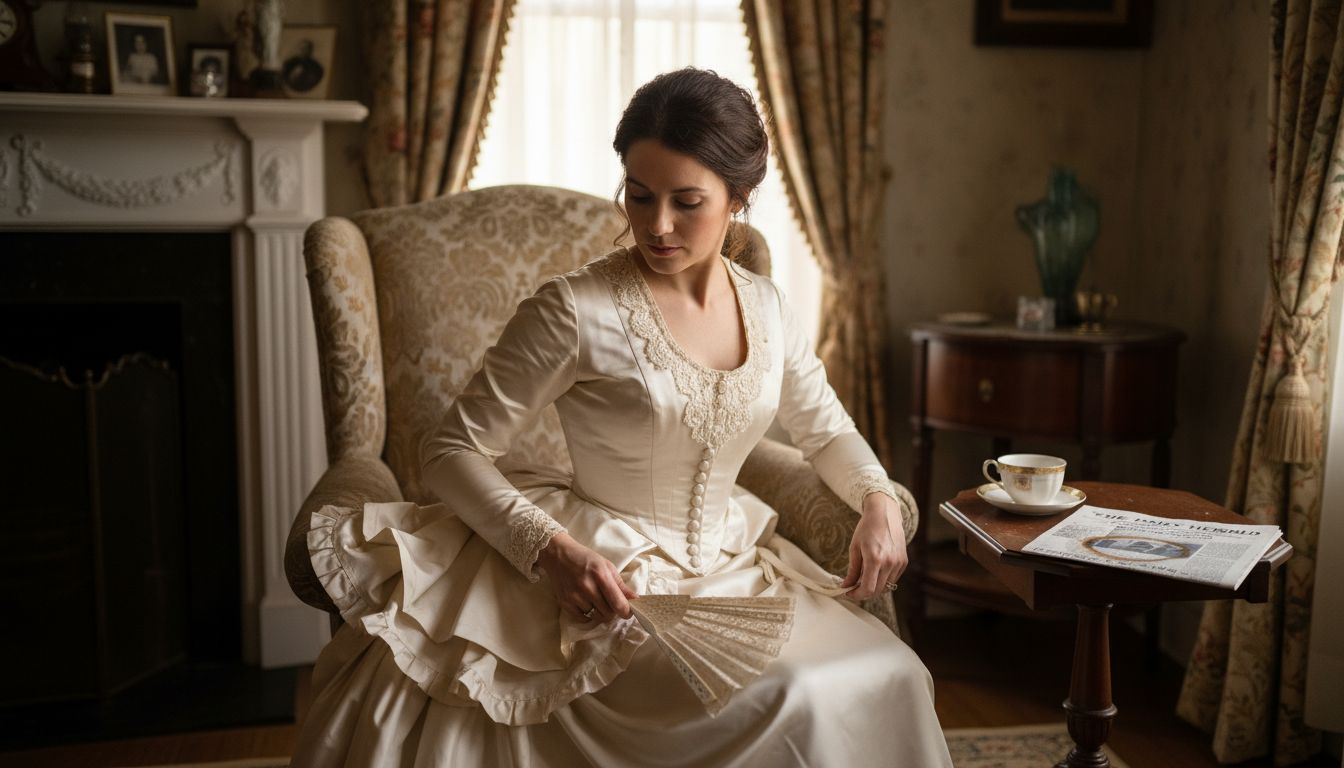
Bustles consisted of wire frames, padded cushions, or fabric draped frameworks attached at the natural waistline. They supported elaborate fabric arrangements creating sculptural silhouettes. Gowns became increasingly tailored with fitted bodices, structured sleeves, and long trains for formal occasions.
Late Victorian dress communicated wealth through:
- Expensive fabric yardage: Bustles required extensive fabric for draping, pleating, and train construction
- Professional tailoring: Achieving proper fit and structure demanded skilled dressmakers
- Elaborate ornamentation: Beading, embroidery, lace insertions, and contrasting fabrics added visual complexity
| Feature | Early Crinoline Era | Late Bustle Era |
|---|---|---|
| Volume placement | All around bell shape | Concentrated at back |
| Bodice style | Fitted but rounded | Sharply tailored, structured |
| Sleeve type | Pagoda or bell sleeves | Fitted or leg of mutton sleeves |
| Overall effect | Soft, romantic fullness | Architectural, dramatic projection |
Pro Tip: Peplum tops and skirts with back detail echo bustle aesthetics without period costume territory.
The bustle silhouette transitioned fashion toward the straighter lines that would characterize 1900s Edwardian styles. Understanding these shifts helps appreciate how each era’s fashion reflected changing aesthetic values and social priorities.
Accessories and social significance
Accessories like hats and gloves completed 1800s fashion while conveying crucial social information about class, occasion, and propriety. These elements weren’t merely decorative but carried specific meanings within Victorian etiquette systems.
Popular accessories evolved throughout the century:
- Hats and bonnets: Styles ranged from Empire era simple straw hats to elaborate Victorian creations featuring feathers, flowers, and ribbons
- Gloves: Required for public appearances, with different lengths and materials indicating formality levels
- Shawls and wraps: Cashmere and paisley shawls provided warmth while displaying wealth and taste
- Jewelry: Cameos, lockets, brooches, and mourning jewelry communicated personal sentiment and social bonds
- Parasols: Protected complexions while serving as elegant accessories and social props
Accessories offered women opportunities for personal expression within strict dress codes. A carefully chosen brooch or uniquely trimmed bonnet allowed individual style while maintaining social respectability. Quality and appropriateness mattered tremendously.
Different occasions demanded specific accessory combinations. Morning calls required gloves and simple bonnets. Afternoon promenades called for parasols and decorative shawls. Evening events demanded elaborate jewelry and fans. Mastering these distinctions signaled social competence and breeding.
Pro Tip: Modern casual accessories can reference vintage styles through vintage inspired brooches, delicate gloves, or structured handbags without full period looks.
Accessories transformed basic garments into complete outfits while broadcasting wearers’ social awareness and economic status. They remain powerful tools for elevating contemporary vintage inspired looks.
Impact of industrial revolution on fashion production
Technological innovations like sewing machines revolutionized garment production during the mid 1800s, fundamentally altering who could access fashionable clothing and how quickly styles evolved. The industrial revolution democratized fashion in unprecedented ways.
Key innovations transformed manufacturing:
- Sewing machine invention: Isaac Singer’s practical sewing machine patented in 1851 accelerated garment construction from days to hours
- Power looms: Mechanized weaving dramatically increased fabric production while reducing costs
- Synthetic dyes: William Perkin’s 1856 mauveine dye discovery created vibrant, affordable color options
- Pattern systems: Standardized sizing and printed patterns enabled home sewing and ready to wear industries
- Factory production: Centralized manufacturing replaced individual seamstresses for many garment types
These advances made elaborate crinolines, layered dresses, and decorative trim accessible beyond wealthy elites. Middle class women could purchase fashionable garments or fabrics at prices unimaginable decades earlier. Fashion magazines proliferated, spreading style information rapidly across regions and classes.
The evolution of women’s fashion accelerated as production capabilities expanded. Styles that once required months of handwork became achievable in weeks. This speed enabled faster trend cycles and greater stylistic diversity.
Yet industrialization created tensions. Mass production threatened artisan livelihoods while raising questions about quality and authenticity. These debates about handcraft versus machine production continue in contemporary fashion conversations around fast fashion and sustainable practices.
Common misconceptions about 1800s fashion
Popular culture portrays Victorian clothing as universally restrictive and impractical. Reality reveals lighter fabrics and flexible styles that accommodated active lifestyles, especially in informal settings and warm weather.
Debunking major myths:
- Myth: All Victorian women wore tight corsets constantly: Many informal day dresses, summer styles, and undergarments omitted corsets entirely or used lighter alternatives
- Myth: Dresses were impossibly heavy: Formal gowns could weigh 15 to 20 pounds, but everyday cotton dresses weighed far less and allowed comfortable movement
- Myth: Women couldn’t breathe or move: Properly fitted corsets distributed pressure and many women performed physically demanding tasks while corseted
- Myth: Fashion ignored practicality: Working class styles prioritized function with shorter hems, durable fabrics, and simplified construction
Victorian fashion encompassed tremendous variety across class, region, and occasion. A wealthy woman attending an evening ball wore vastly different garments than a farmer’s wife doing household chores. Conflating formal wear with everyday clothing creates distorted impressions.
Pro Tip: When researching vintage styles, examine photographs and primary sources rather than relying on costume dramas that often exaggerate for visual impact.
Understanding authentic historical practices prevents perpetuating misconceptions about vintage fashion that limit appreciation of period clothing’s genuine versatility. This knowledge empowers more thoughtful and accurate vintage inspired styling today.
Social class influence on fashion styles
Upper class elaborate gowns contrasted sharply with working class practical attire, making clothing a immediately visible class marker throughout the 1800s. Fashion functioned as social language communicating economic status, occupation, and aspirations.
Class distinctions manifested through multiple factors:
- Fabric quality: Wealthy women wore silk, fine wool, and imported lace while workers used cotton, linen, and coarse wool
- Garment complexity: Upper class dresses featured multiple pieces, elaborate trim, and seasonal wardrobes versus workers’ few versatile garments
- Color and decoration: Rich dyes and embellishments signaled disposable income unavailable to laborers
- Fit and tailoring: Custom fitted garments by professional dressmakers contrasted with home sewn or ready made working class clothes
- Cleanliness and maintenance: Keeping white muslin or pale silk pristine required servants and leisure time
| Class | Typical Fabrics | Style Characteristics | Wardrobe Size |
|---|---|---|---|
| Upper | Silk, velvet, fine lace | Elaborate trim, seasonal changes, formal and informal sets | 20 plus garments |
| Middle | Quality cotton, wool, modest silk | Simplified versions of fashionable styles, practical decoration | 8 to 12 garments |
| Working | Coarse cotton, linen, wool | Durable construction, shorter hems, minimal trim | 3 to 5 garments |
Fashion served as political expression too. Reform dress movements advocated simpler, healthier clothing while challenging class and gender restrictions. Some women deliberately adopted practical styles as feminist statements.
The evolution of fashion throughout the 1800s both reflected and reinforced social hierarchies. Understanding these dynamics reveals how clothing functioned as far more than personal aesthetic choice.
Transition from empire to victorian style
The shift from neoclassical Empire to Victorian structures occurred gradually from the 1820s through 1840s, reflecting major industrial and social transformations reshaping Western society. This wasn’t sudden change but evolutionary adaptation.
Empire styles dominated through approximately 1820, with high waistlines and flowing silhouettes remaining fashionable. During the 1820s and 1830s, waistlines gradually descended to natural positions while skirts gained volume through petticoats. Sleeves expanded dramatically into leg of mutton styles by 1830.
The 1840s marked decisive transition toward Victorian aesthetics. Corsets returned to prominence, creating defined waists. Skirts continued expanding, eventually requiring crinoline support by the 1850s. Bodices became more structured with fitted sleeves and modest necklines replacing earlier exposed décolletage.
| Period | Waistline | Skirt Shape | Sleeve Style | Overall Aesthetic |
|---|---|---|---|---|
| 1800 to 1820 | Just below bust | Straight, flowing | Small, fitted | Classical simplicity |
| 1820 to 1840 | Descending to natural | Moderate fullness | Gigot/leg of mutton | Romantic transition |
| 1840 to 1860 | Corseted natural waist | Bell shape, crinoline | Fitted or pagoda | Victorian structure |
These changes mirrored shifting ideals of femininity from neoclassical republican virtue to Victorian domestic angel. Industrial prosperity enabled middle class fashion participation, creating demand for visible status markers through elaborate clothing. Growing textile production supplied materials for increasingly complex garments.
The evolution across decades demonstrates how fashion responds to technological capabilities, economic conditions, and cultural values simultaneously. Understanding this transition helps contextualize both earlier and later 19th century styles.
Modern application of 1800s fashion
Blending romantic vintage silhouettes with modern comfort creates unique looks that honor historical aesthetics while fitting contemporary lifestyles. Fashion forward women can thoughtfully incorporate 1800s elements without costume territory.
Practical integration strategies:
- Empire waist pieces: Choose Empire waist dresses or tops in modern fabrics like jersey or lightweight cotton for comfortable vintage flair
- Victorian inspired details: Look for high necklines, lace trim, or cameo brooches that reference period aesthetics subtly
- Bustle echoed volume: Peplum styles, draped backs, or asymmetrical hemlines evoke bustle era drama in wearable formats
- Vintage accessories: Incorporate delicate gloves, structured bags, or vintage inspired jewelry to elevate contemporary outfits
- Color palettes: Soft pastels, deep jewel tones, or classic black and white reference 1800s color preferences
Pro Tip: Start with one vintage inspired element per outfit rather than full period looks to maintain modern relevance and personal style.
Balance remains crucial. Pair a Victorian high neck blouse with modern jeans and boots rather than a full period skirt. Choose Empire waist dresses in contemporary prints instead of exclusively floral patterns. Mix vintage elements with distinctly modern pieces.
Wearing vintage clothing successfully requires understanding proportions and context. What worked in the 1800s may need adaptation for 2026 functionality. Similarly, fashion influencer vintage styling often provides inspiration for translating historical aesthetics into wearable contemporary looks.
Authenticity matters less than thoughtful interpretation. Your goal isn’t historical reenactment but creative expression drawing on 1800s fashion’s rich visual language. Experiment with different elements to discover what resonates with your personal style.
Explore vintage inspired styles at Be Juliet
After discovering how 1800s fashion blended elegance with evolving social values, you’re ready to explore how these timeless elements translate into modern wardrobes. Be Juliet offers carefully curated pieces that echo vintage sophistication while delivering contemporary comfort and versatility.
Our Bethany casual jumpsuit captures Empire era ease with its relaxed silhouette and flowing lines, perfect for effortless summer style. The Basic Bae turtleneck sweater references Victorian modesty through its high neckline while offering cozy modern wearability. Each piece at Be Juliet balances classic inspiration with the comfort and confidence today’s woman deserves, making vintage influenced style accessible and authentic for your everyday life.
What defined women’s fashion in the 1800s?
Women’s fashion in the 1800s evolved through three distinct phases reflecting social and technological change. The Empire silhouette dominated the early century with high waistlines and flowing simplicity inspired by neoclassical ideals. Mid century Victorian styles introduced structured corsetry and crinoline cages creating hourglass shapes that emphasized domesticity and class status. The late century bustle era concentrated dramatic volume at the back with architectural tailoring. Each phase responded to political revolutions, industrial advances, and shifting gender roles that redefined feminine ideals throughout the century.
How did social class influence 1800s women’s fashion?
Social class profoundly shaped every fashion aspect from fabric quality to garment complexity. Upper class women wore expensive silks, elaborate trims, and custom tailored gowns that required servants for maintenance, while working class women chose durable cotton, simplified construction, and practical shorter hemlines. Fashion functioned as immediately visible class language, with clothing choices communicating economic status, social aspirations, and cultural values. Even accessories like gloves and jewelry varied dramatically across classes, reinforcing social hierarchies through visual distinction.
Can 1800s fashion styles be incorporated into modern wardrobes?
Absolutely, through thoughtful adaptation that honors vintage aesthetics while maintaining contemporary wearability. Choose Empire waist dresses in modern fabrics, incorporate Victorian inspired high necklines or lace details, or add vintage accessories like brooches and structured bags to elevate outfits. The key is balancing one or two period elements with distinctly modern pieces rather than attempting full historical recreation. Start with accessories or single garments featuring vintage silhouettes, then build confidence mixing eras as your personal style evolves.